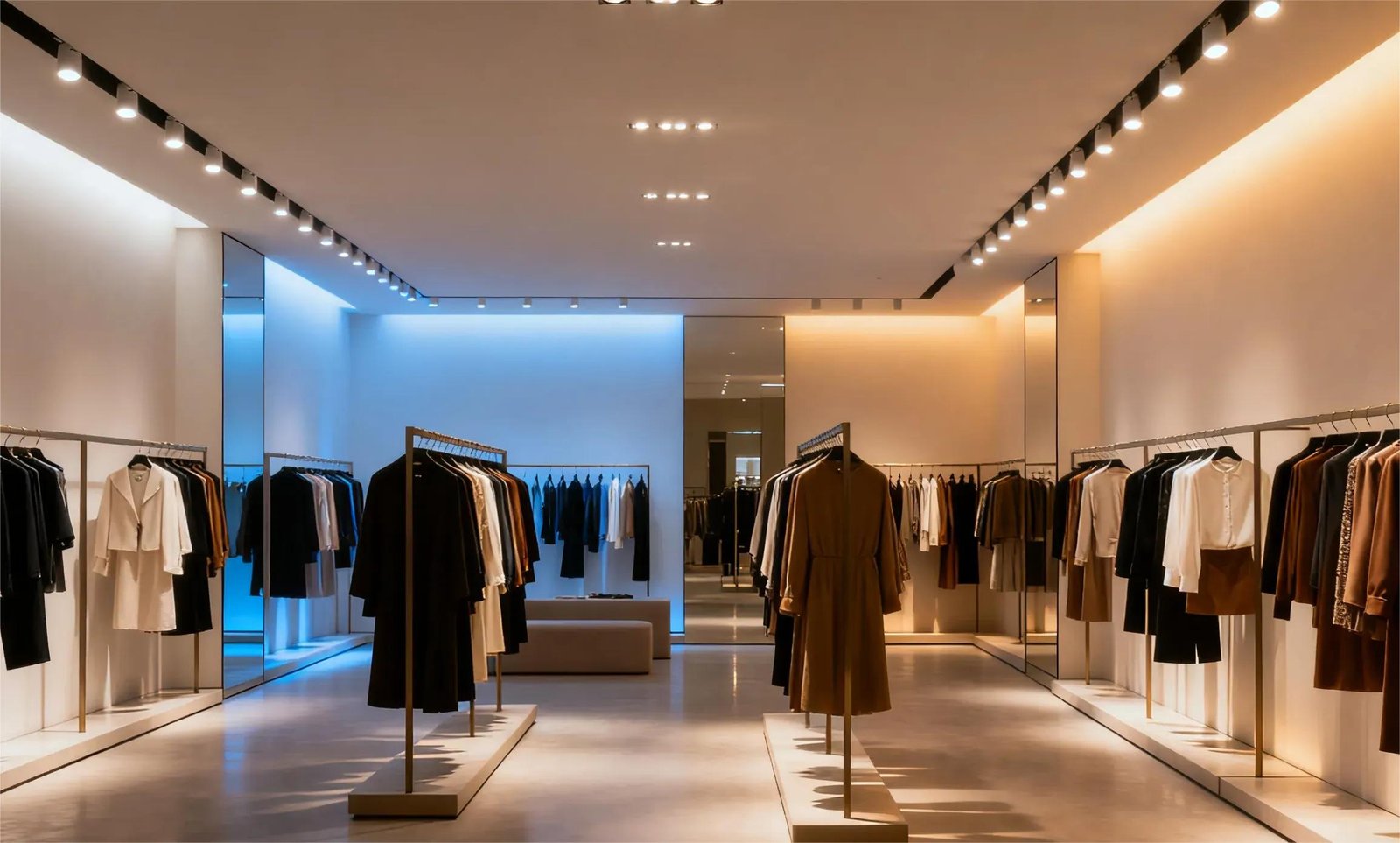
After years in commercial lighting, I’ve noticed retail store owners tend to fall into two camps. One group treats lighting as an afterthought—just throw up some downlights and call it done. The other group invests in it properly, because they understand that the first thing a customer sees when they walk in isn’t the product. It’s the light.
Good lighting makes an ordinary garment look premium. It makes a handbag in the window something people want to reach out and touch. Bad lighting can make designer merchandise look like clearance rack stuff.
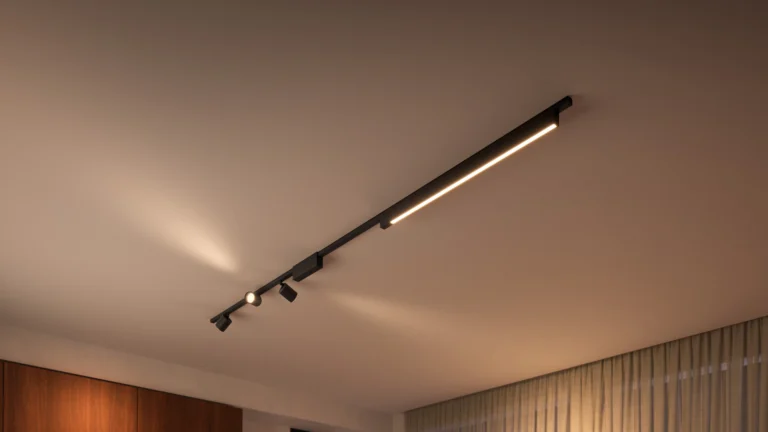
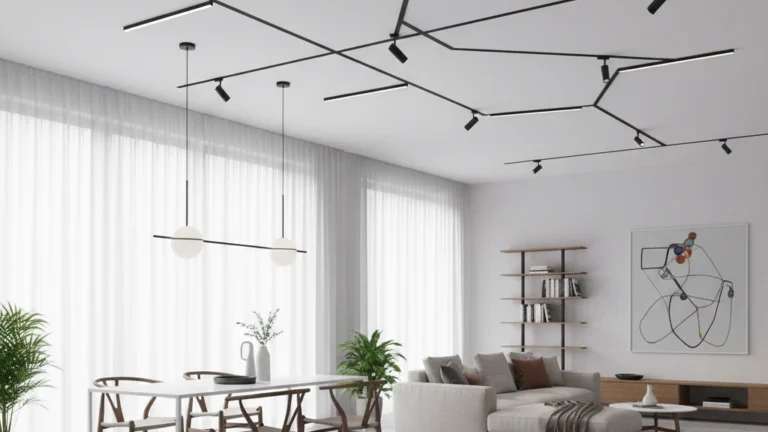
Magnetic track lighting has exploded in retail over the last couple years, and for good reason. Clothing stores change displays weekly. Jewelry stores rotate themes monthly. If every lighting adjustment means calling an electrician, the costs add up fast. With magnetic systems, your staff can reposition fixtures themselves in seconds.
In this article, let’s walk through how to use magnetic track lighting in a retail space, from the storefront window to the fitting rooms. Each zone needs a different approach.
Why Retail Stores Are Switching to Magnetic
Traditional track lights are adjustable too, but you need tools—screwdrivers, aligning connectors, the works. Most staff can’t be bothered. Magnetic fixtures just click into place. Pull one off, move it somewhere else, snap it back on. Done.
We had a women’s clothing client who used to call an electrician every time they changed a window display—$300 a visit, two or three times a month. After switching to magnetic, the store manager handles it herself. The annual savings on electrician calls alone basically paid for the new system.
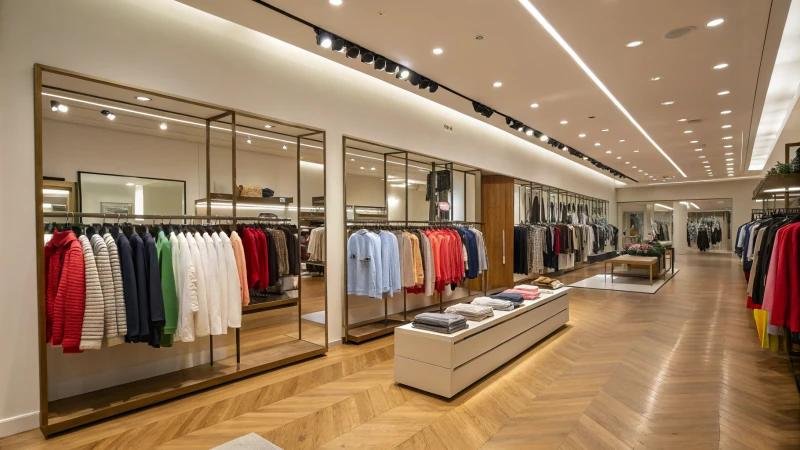
Beyond flexibility, magnetic systems just look cleaner. The profiles are thin and unobtrusive, nothing like the bulky tracks of the past. Higher-end stores have largely moved to magnetic for this reason alone.
And then there’s energy savings. LED is already far more efficient than halogen, and magnetic low-voltage systems push that further. For a 100-square-meter store, we typically see electricity bills cut roughly in half after switching.
The Window Is Your Store’s Face
The window is what stops people on the sidewalk. If it doesn’t pull them in, nothing else matters.
Window lighting is all about layering. You don’t want the whole window at one brightness—that kills any sense of focus. Typically you’d use narrow-beam spots on hero products, then wider beams for background fill. The contrast is what makes products pop.
Beam angle matters a lot here. For small items—jewelry, watches, cosmetics—15 to 20 degree narrow beams create that spotlight effect. For clothing and larger displays, 24 to 36 degree medium beams cover the product properly.
One thing people get wrong: glare on the glass. If the fixture angle is off, people outside just see a reflection, not the display. Aim for roughly a 30-degree incidence angle—enough to illuminate the product without bouncing straight back into customers’ eyes.
And when the seasons change and you redo the window theme? That’s where magnetic really shines. Want a warmer holiday feel? Reposition fixtures, swap in some warmer-temperature modules. Five minutes, no electrician needed.
The Entry Sets the Tone
Those first few seconds after someone walks through the door shape their entire impression of the store.
Don’t make the entrance too dim, but don’t blast it either. 300 to 500 lux is a comfortable range. Color temperature should lean warm—2700K to 3000K feels welcoming.
A lot of stores put decorative pendants at the entrance, which look great but often don’t provide enough actual light. Pair them with magnetic linear modules for base illumination, plus a few spots on the entry display table. You get atmosphere and function.
The Sales Floor Is Where It Matters Most
This is where customers spend the most time, and where lighting design gets nuanced.
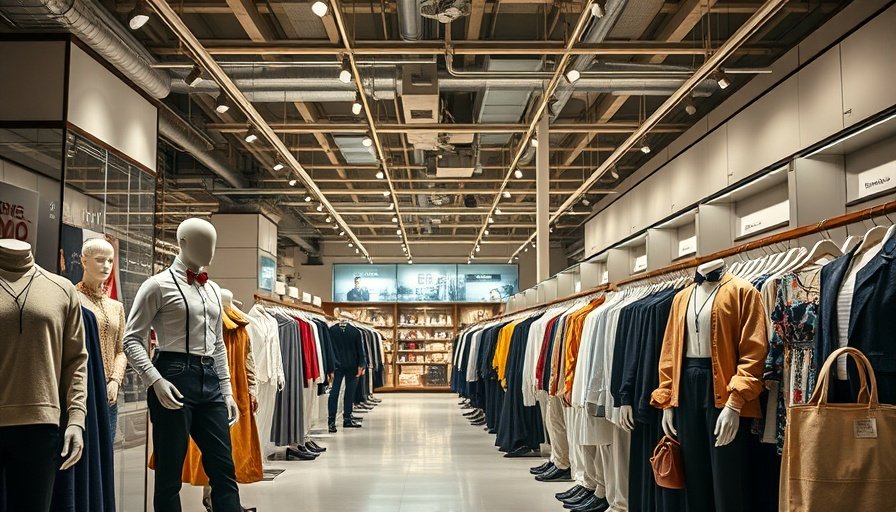
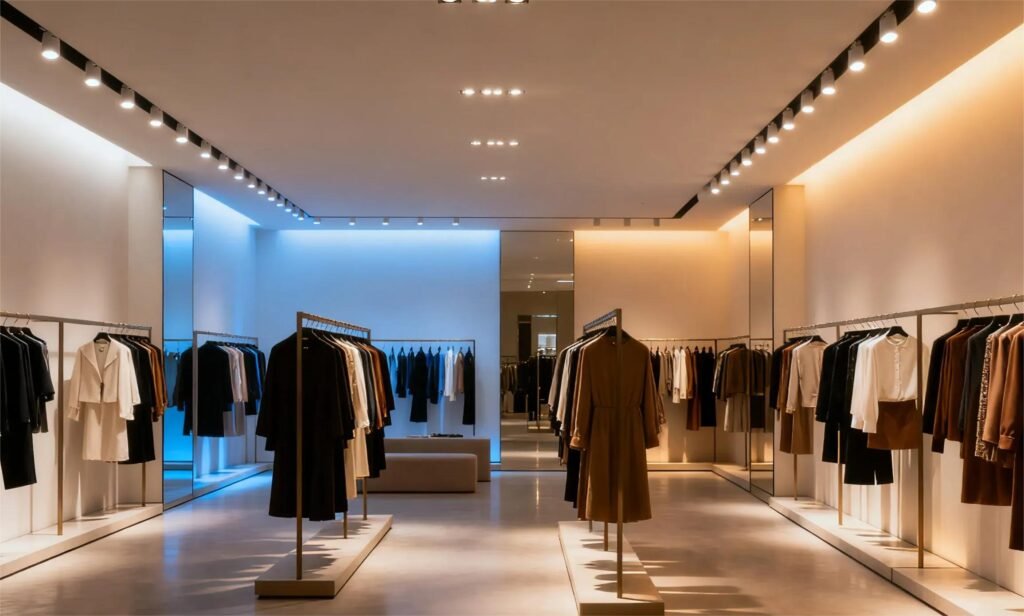
Start with ambient coverage—linear modules or wide-beam spots evenly distributed so there are no dark corners. Then layer accent lighting on top. Featured products, new arrivals, hero displays should be lit two to three times brighter than the surrounding area. The eye is drawn to brightness, so use that deliberately.
Different product categories need different light.
For clothing, color rendering index is everything. CRI 90+ is the minimum, 95+ is ideal. If your CRI is low, the color looks great in-store but different at home—and that’s how you get returns. Color temperature usually lands around 3000K to 3500K for apparel; warm white makes fabric look rich.
For jewelry, narrow-beam spotlights isolate each piece. Diamonds and silver look better under cooler light around 4000K—makes them sparkle. Gold and warm metals prefer 2700K to 3000K, enhances the tone.
For cosmetics, light needs to be even and shadow-free. Customers are testing colors on their skin; if the light is wrong, they pick the wrong shade and return it. Neutral white around 4000K with CRI 95+ is the standard.
Here’s a mistake I see constantly: one color temperature everywhere. You can actually use two—one for ambient, a slightly different one for accents. Say 3000K for general, 3500K for featured products. The subtle difference makes the accents stand out without looking disjointed.
Fitting Rooms Make or Break the Sale
Most people don’t realize how directly fitting room lighting affects conversion rate.
A customer decides whether they look good in something in that small room. If the light makes them look sallow, or casts shadows under their eyes, they won’t buy—no matter how nice the garment is.
Overhead spotlights are the enemy here. Light from above creates shadows under the eyes and chin. Nobody looks their best under that.
The right approach is lighting from the front, on either side of the mirror—like a makeup mirror. Face-level, even illumination. That’s what makes people look good.
Color temperature 3000K to 3500K, CRI 95+. Keep it moderate in brightness, not harsh. You want a flattering, comfortable environment.
We had a boutique client who redid their fitting room lighting and swore their conversion rate went up. Can’t prove it was all the lights, but at minimum, customers were spending more time in there and trying on more pieces.
Checkout and Impulse Buys
The area around the register usually holds small add-ons—lip gloss, socks, accessories. The few minutes while waiting in line is when people grab these.
Hit those impulse displays with a focused spotlight. Just a little brighter than the surroundings, enough to draw the eye while they wait.
The register itself should feel calm. Warm light, 200 to 300 lux. You don’t want customers feeling interrogated while they pay.
Aisles and Customer Flow
Aisles exist to move people deeper into the store. Light can guide that movement.
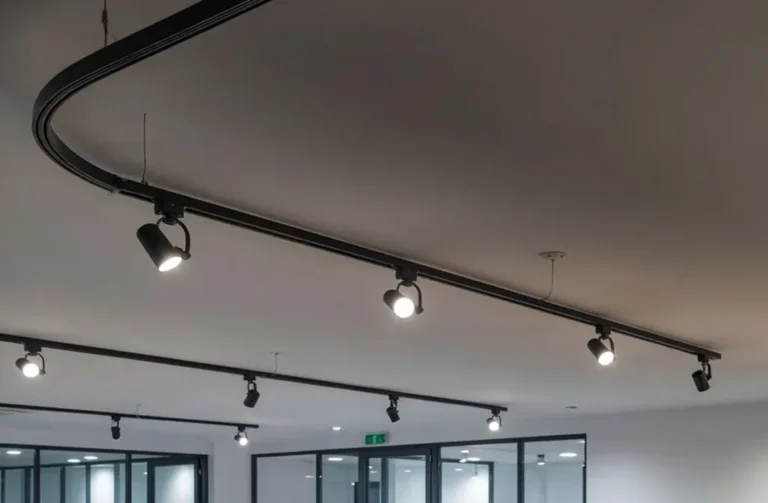
Slightly brighter lighting at the end of an aisle naturally draws people forward. You can also use the track itself—curved magnetic runs following the aisle path create a visual line that people follow.
Keep aisle lighting even. Dark patches make people uncomfortable and less likely to wander.
Choosing Beam Angles
This is the question I get most, so here’s the quick version:
15 to 20 degrees (narrow): small products—jewelry, watches, single featured items.
24 to 30 degrees (medium): clothing, handbags, footwear displays.
36 to 45 degrees (wide): wall washing, large display areas.
60+ degrees (flood): ambient lighting, aisles, general coverage.
Narrower isn’t better. Match the beam to the size of what you’re lighting. Too narrow on a large product and you get hot spots and dark edges.
Color Temperature Isn’t One-Size-Fits-All
A lot of owners think brighter equals more upscale. Not true.
2700K (warm): high-end apparel, luxury goods, intimate boutiques.
3000K (soft white): the workhorse, works for most retail.
3500K (neutral): activewear, fast fashion, clean modern feel.
4000K (cool white): pharmacies, supermarkets, electronics.
5000K+ (daylight): galleries, diamond jewelry.
Don’t mix more than two color temperatures in a space. More than that and it starts to look inconsistent.
Smart Lighting Is the New Standard
Any store of reasonable size these days should be looking at smart controls.
Different scenes for different times of day. Brighter and energetic in the morning. Normal for peak afternoon hours. Warmer and softer in the evening.
For sales events, crank up the accent lighting or shift the color temperature to create urgency. Holidays? RGBW modules can throw in theme colors.
All of this switches from a phone app or wall panel. No climbing ladders, no adjusting individual fixtures.
Magnetic track plus smart controls is basically where retail lighting is heading.
What Does This Cost?
No single answer, depends on size and finish level.
Roughly $200 to $500 per square meter, materials and installation. A 100-square-meter store runs $20,000 to $50,000. Flagship and high-end locations go higher because of fixture quality and design complexity.
But it’s an investment that pays back. Better lighting lifts the store’s perceived value, can improve conversion, and cuts electricity bills. Most stores see payback within a year or two through energy savings and increased sales.
Mistakes That Cost Stores Money
First: uniform brightness everywhere. No hierarchy, no focus. Customers walk through and nothing registers.
Second: glare. Unshielded fixtures mean customers look up and get blinded. Bad experience, and they leave faster.
Third: overhead light in fitting rooms. Already covered this, but it’s worth repeating—people won’t buy what they don’t look good in.
Fourth: low CRI fixtures. Cheap fixtures with CRI in the 70s make everything look washed out and cheap. Your products deserve better.
Fifth: no maintenance plan. Drivers need accessible locations. Fixtures should be a standard type so replacements are easy.
Wrapping Up
Retail lighting isn’t just about putting fixtures on the ceiling. It’s part of the customer experience. How comfortable people feel, how long they stay, whether they buy—light is quietly influencing all of it.
Magnetic track gives retailers a level of flexibility traditional systems can’t match. The lighting can evolve with your displays, your seasons, your promotions.
If you’re opening a new store or renovating an existing one, budget properly for lighting. It’s one of the highest-ROI investments you can make.
We’ve worked on plenty of retail projects, from fashion chains to jewelry boutiques. If you’d like help with a layout or quote, get in touch. You can also browse our магнитные трековые системы—full range of fixtures and accessories.
Running a store is hard. Every detail that makes it easier is worth getting right.